What makes Irish crochet 'Irish'?
A famine, a convent, and a lace that saved thousands of families.
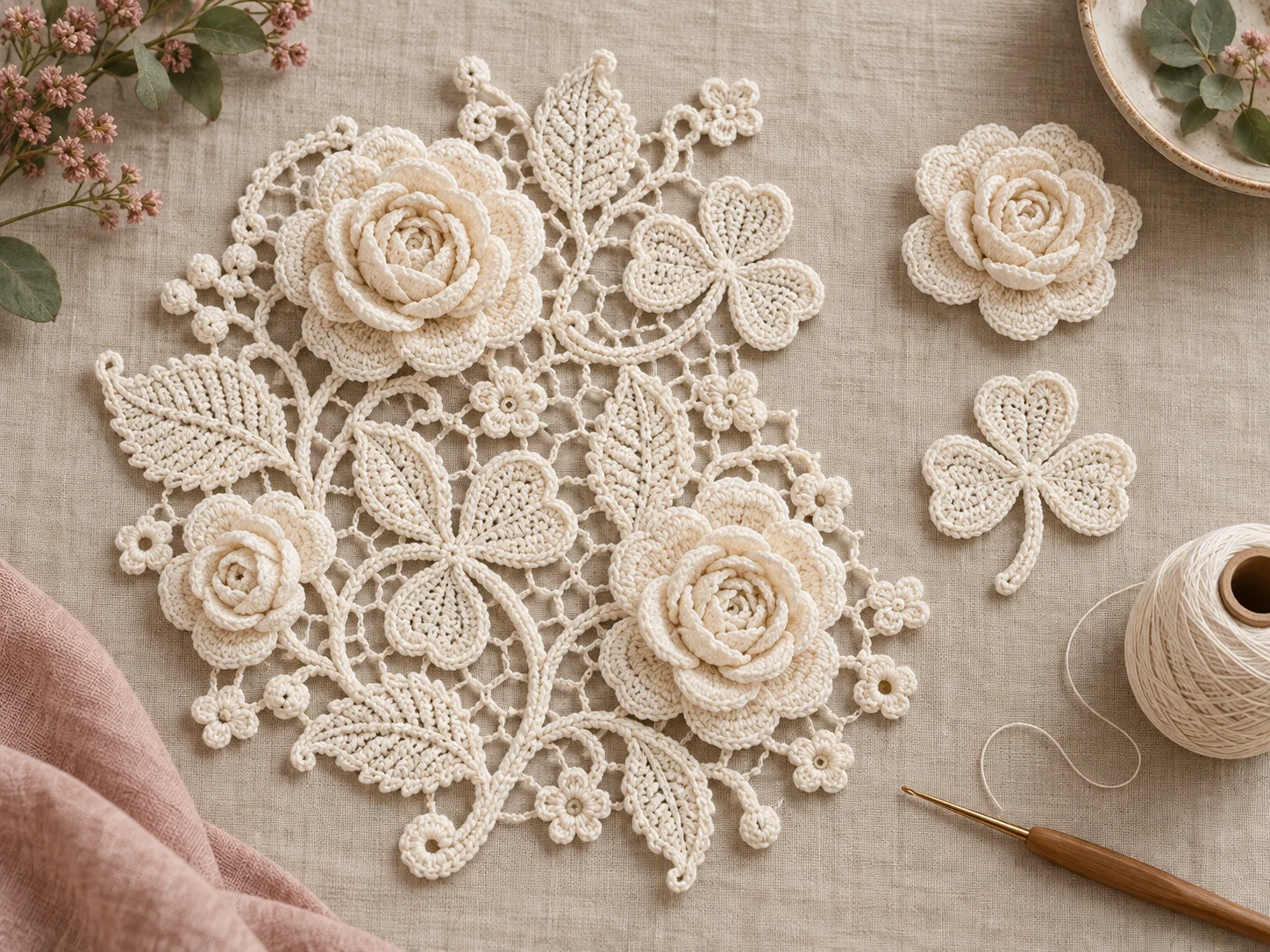
In the 1840s, as famine swept through Ireland, a group of nuns in the convents of Cork began teaching local women a technique adapted from Venetian needle lace — but worked with a crochet hook, which was faster to learn and needed almost no equipment. A hook, a spool of fine cotton, and a pair of hands were enough to feed a family.
A lace built from flowers
What sets Irish crochet apart is its construction. Motifs — roses, shamrocks, leaves, grapes — are worked separately, one by one, often padded over a heavier cord to give them sculptural relief. Only afterwards are they joined, floating on a hand-worked mesh background. No two makers assembled them quite the same way, which is why no two pieces of true Irish crochet are ever identical.
Each motif is a small sculpture; the mesh is the air between them.
By the 1850s Irish lace was worn in Paris and London salons, and entire villages lived on it. The technique crossed to France, Austria and eventually China, where it met local silk-thread traditions.
Why we still make it by hand
Machines can imitate the look of the mesh, but not the padded, dimensional motifs — their density and relief still require a hook held in a hand. A single collar can take sixty hours; a shawl, several hundred. When you hold a piece of Irish crochet, you are holding time made visible.
See the pieces these stories are made of
View collections